
Verde Valley Historical Societies and Museums
Historical Society Museums
Camp Verde
The Camp Verde Visitor’s Center, located in the heart of Historical Downtown Camp Verde, offers visitors a welcoming gateway to explore this charming Arizona destination. Housed in a beautifully preserved old schoolhouse, the Center serves as both an information hub and a meaningful piece of local history.

Clarkdale
The museum is housed in Clarkdale’s old clinic building, which dispensed medicine and treated minor injuries of the smelter workers and their families on a 24-hour basis. Upon its closure, the building became town offices; a jail was constructed in the boiler room while the police department occupied the basement. Later, the building also housed the city’s library and the Department of Motor Vehicles.

Jerome
For more than half a century, Jerome was a virtual ghost town. It wasn’t until the formation of the Jerome Historical Society in 1953 and the opening of the Jerome Mine Museum that the town came alive again. Today, when you visit Jerome and its historic buildings, you are given an opportunity to take a step back in time, feel the past and experience life as it might have been in Arizona’s rough and rugged days.

Sedona
The Sedona Heritage Museum, housed in the original Jordan family farmstead, is situated in the Jordan Historical Park, a 4.8 acre oasis in Uptown Sedona. The Museum serves as a venue for several signature annual events.

Other Historical Societies
Rimrock and Lake Montezuma
Its purposes are to research Beaver Creek area history; acquire and display historical writings, photographs, artifacts, antiques, and other museum items; research and identify historical buildings, develop and carry out activities in support of the continuing history of ‘Beaver Creek’ inhabitants and community, which will enrich and elevate the educational and cultural level of members and residents of the community.
Cornville
The mission of the Cornville Historical Society is to gather, preserve and share information about the history of the Cornville-Page Springs area from the time of pioneer settlement in the 1870's to the present. The Society does research, keeps records, collects historical items, and sponsors educational activities relating to rural life in the historic Lower Oak Creek area.
Other Museums
Clarkdale
The Arizona Copper Art Museum tells a genuine story, one that marries Arizona’s greatest treasure with world legends and fantastic art by returning copper home to where it all began. Starting in towns like Clarkdale, copper leaves, and then blossoms into an amazing story of the world’s most beautiful metal. Find out why Arizona is nicknamed the Copper State.

Sedona
This is the largest known petroglyph site in the Verde Valley, as well as one of the best-preserved. Various rock art styles have been defined for the prehistoric Southwest. One of these styles identified here -- the Beaver Creek Style -- has is characteristic of the Southern Sinagua between 1150 and 1400 CE.

Camp Verde
Anglo settlers began to settle the Verde Valley in the mid-19th century, growing corn and other crops to serve Prescott and nearby miners. The rapid increase in population disrupted the hunting and gathering environments of the local Dilzhe'e Apache and Yavapai. In turn, they raided the farmers' crops for food. The farmers requested military protection from the United States Army, with troops arriving in 1865. Several posts over the next few years were established, including Camp Lincoln (1866–1871), a mile north of today's Fort Verde, which was established at its current location in 1871.

Jerome
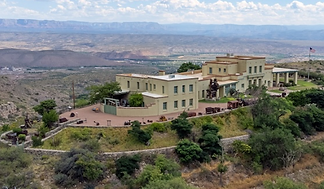
The Douglas Mansion has been an eye-catching landmark in Jerome since 1916, when James S. Douglas built it on the hill just above his Little Daisy Mine. This former home is now a museum devoted to the history of the Jerome area and the Douglas family. The museum features photographs, artifacts and minerals in addition to a video presentation and a 3-D model of the town with its underground mines.
Camp Verde
Montezuma Castle is situated about 90 feet up a sheer limestone cliff, facing the adjacent Beaver Creek, which drains into the perennial Verde River just north of Camp Verde. It is one of the best-preserved cliff dwellings in North America, in part because of its ideal placement in a natural alcove that protects it from exposure to the elements. Studies suggest that the cliff dwelling was largely constructed between 1125 CE and 1173 CE. An even larger settlement ("Castle A") with an estimated 45 rooms, lay nearby. Castle A site was destroyed by fire sometime between 1375 CE and 1395 CE and both dwellings were depopulated shortly thereafter.

Clarkdale
Tuzigoot National Monument preserves a 2- to 3-story pueblo ruin on the summit of a limestone and sandstone ridge, 120 feet above the Verde River floodplain.
Built by the Sinagua people between 1125 and 1400 CE, the pueblo has 110 rooms. Tuzigoot is the largest and best preserved of the many Sinagua pueblo ruins in the Verde Valley.

Camp Verde
Founded in 2010, the museum contains exhibits on Native American culture in the Verde Valley. The Museum comprises ten curated galleries on a single floor, with rotations from the Museum’s collections and periodic special limited exhibitions. Established on nearby site containing Native American pit-houses are a heritage pathway and garden. The museum also hosts the Verde Valley Archaeology Fair and the International Archaeology Film Festival.
